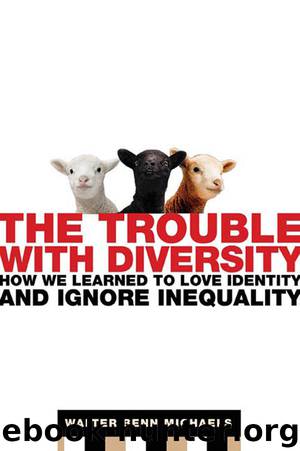
The Trouble with Diversity by Walter Benn Michaels
Author:Walter Benn Michaels
Language: eng
Format: epub
ISBN: 9781466818811
Publisher: Henry Holt and Co.
5
Who Are We? Why Should We Care?
In January 2006, Evo Morales was inaugurated as the new president of Bolivia, twice. Once was in La Paz, the capital, where, wearing a dark suit (but no tie, as befits his populist image), he was sworn in before thousands of Bolivians and the representatives of many other governments. The other time—it was actually the day before—was about forty miles from La Paz, in Tiwanaku, among the ruins of Bolivia’s major pre-Columbian city. This time he was barefoot and dressed in the red robes worn by pre-Incan sun priests. In La Paz, he took the oath of office in Spanish; in the ruins of the temple at Tiwanaku, he was, according to the Daily Telegraph, “invested with sacred powers by two shamans using the indigenous Aymara language.”1 On both occasions, however, he vowed to resist globalization and neoliberalism.
How successful Morales will be in opposing globalization, I have no idea. My interest here is in the two different constituencies represented by the two inaugurations, and in the two very different ideas of resistance implied by them. The party Morales leads is the MAS party. (MAS is the acronym for Movimiento al Socialismo, movement toward socialism.) He is also the first indigenous head of the Bolivian state in over four hundred years, since the Spanish conquest. Practically speaking, there’s clearly a significant overlap between these two things in Bolivia today (Morales got 54 percent of the vote). But there’s also a significant difference. To be a socialist is to have an ideology. Socialists believe in some of the things Morales believes in, like nationalizing the Bolivian water system, which had, at the urging of the International Monetary Fund, been privatized. To be an Aymara Indian is to have not an ideology but an identity. When Morales talks about “nationalizing industry,” he is speaking as a socialist; when he talks about fulfilling the dreams “of our ancestors,” he is speaking as an Indian. The ancestors of many members of MAS (the nonindigenous “middle class, the working class, the professionals, even the businessmen” whom he thanked in his inaugural speech) no doubt had exactly the opposite dreams.
This difference—between who your ancestors are and what your beliefs are—functions in much the same way as the difference between who your ancestors are and how much money you have. Both work to obscure the fundamental problem of economic inequality. A socialist and an Indian can fight for the same cause but for different reasons. Here, for example, are two reasons you might want to resist the privatization of water rights. You might, if you’re a socialist, want to minimize corporate ownership of public utilities. You might, if you’re an Indian, want to hang on to what an article in the journal Cultural Survival calls your “cultural traditions,” distributing water in the way your ancestors did.2 And although in this case, the different reasons lead to the same result, it’s obvious that they needn’t and often won’t. If what you want is
Download
This site does not store any files on its server. We only index and link to content provided by other sites. Please contact the content providers to delete copyright contents if any and email us, we'll remove relevant links or contents immediately.
| Anthropology | Archaeology |
| Philosophy | Politics & Government |
| Social Sciences | Sociology |
| Women's Studies |
The Secret History by Donna Tartt(19291)
The Social Justice Warrior Handbook by Lisa De Pasquale(12222)
Thirteen Reasons Why by Jay Asher(8992)
This Is How You Lose Her by Junot Diaz(6954)
Weapons of Math Destruction by Cathy O'Neil(6362)
Zero to One by Peter Thiel(5863)
Beartown by Fredrik Backman(5835)
The Myth of the Strong Leader by Archie Brown(5550)
The Fire Next Time by James Baldwin(5501)
How Democracies Die by Steven Levitsky & Daniel Ziblatt(5271)
Promise Me, Dad by Joe Biden(5189)
Stone's Rules by Roger Stone(5128)
A Higher Loyalty: Truth, Lies, and Leadership by James Comey(5017)
100 Deadly Skills by Clint Emerson(4968)
Rise and Kill First by Ronen Bergman(4833)
Secrecy World by Jake Bernstein(4794)
The David Icke Guide to the Global Conspiracy (and how to end it) by David Icke(4770)
The Farm by Tom Rob Smith(4545)
The Doomsday Machine by Daniel Ellsberg(4538)
